
Buying a home in Ontario doesn't just change your address. It changes the shape of your entire retirement timeline — your savings rate, your tax position, your net-worth trajectory, and often the date you can actually stop working. For most Canadian households, the home becomes the single largest asset on the balance sheet, which means the decisions made at purchase echo for twenty-five years.
I've spent nearly two decades running retirement plans for Ontario families as a Personal Financial Planner and Chartered Investment Manager, and I also work the other side of the transaction as a licensed Realtor and mortgage broker. That vantage point — seeing the purchase, the financing, and the retirement plan as one system — is where this article comes from. Below, I'll walk through exactly how a home purchase moves your retirement timeline, and then run the numbers on the question I get asked most: is it better to put 20% down, or put 10% down and invest the difference?
What a Home Actually Does Inside a Retirement Plan
A principal residence contributes to retirement in three distinct ways, and it's worth separating them because they behave very differently.
Forced savings. Every mortgage payment includes principal repayment. Behaviourally, this is the most reliable savings mechanism most households ever have, because it isn't optional. Renters can theoretically invest the equivalent amount, but in practice, most don't sustain it for twenty-five years.
Tax-free growth. Canada's principal residence exemption means the appreciation on your home is not subject to capital gains tax when you sell. In a province where long-run home price growth has been meaningful, that exemption is one of the most valuable tax shelters available to Canadian families — larger, for many households, than a lifetime of TFSA room.
Reduced retirement spending. A paid-off home at retirement removes your largest monthly expense. In planning terms, entering retirement mortgage-free can reduce your required annual income by $30,000 to $50,000 before tax, which directly shrinks the portfolio you need to have accumulated. This is why the mortgage-free date and the retirement date are so tightly linked in every plan I build.
The trade-off is concentration and carrying cost. A home is illiquid, it consumes cash flow that would otherwise fill RRSPs, TFSAs, and FHSAs, and property tax, insurance, and maintenance in Ontario typically run 1% to 2% of the home's value annually. A retirement plan that treats the home as a pure asset without accounting for what it displaces will be too optimistic.
What Changes the Day You Buy
The purchase itself triggers several shifts in a retirement plan's assumptions.
First, cash flow gets reallocated. A household saving $2,500 a month as renters may find only $800 a month available after ownership costs. That's not automatically bad — a portion of the mortgage payment is building equity — but it changes where the growth happens: from diversified, liquid portfolios to a single Ontario property.
Second, registered accounts often get raided. The Home Buyers' Plan now allows first-time buyers to withdraw up to $60,000 from an RRSP, and the FHSA allows $8,000 per year to a $40,000 lifetime limit. These are excellent tools, but an HBP withdrawal pauses compounding on that capital while it's repaid. A plan needs to model that gap honestly rather than pretend the RRSP was never touched.
Third, closing costs are pure friction. Ontario's land transfer tax on an $800,000 purchase is $12,475 (double it inside Toronto, before the first-time buyer rebates of up to $4,000 provincially and $4,475 municipally). That money leaves the retirement equation permanently, which is one reason frequent moves are quietly corrosive to retirement timelines.
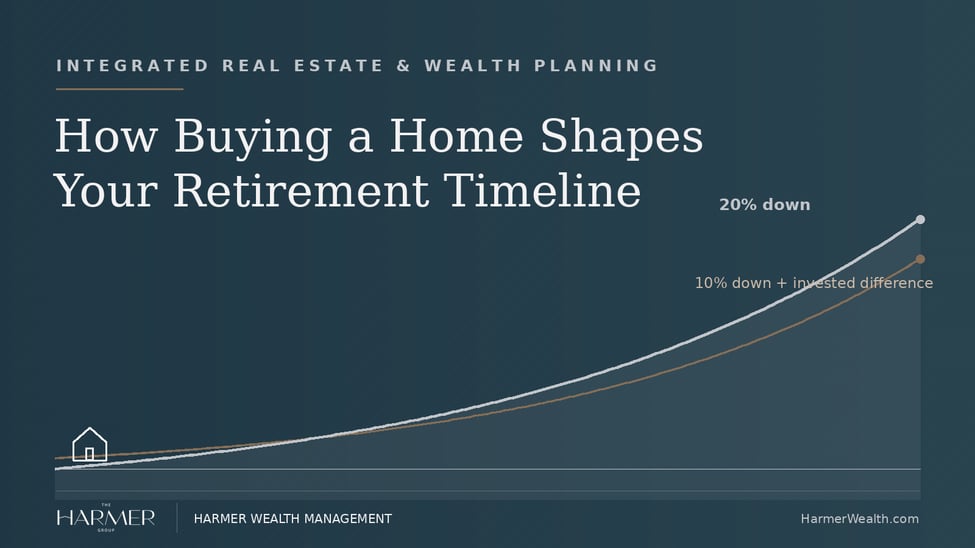
The Breakdown: 20% Down vs. 10% Down Plus Investing the Difference
Here's the analysis I run for clients weighing this decision. The numbers below use a realistic Ontario purchase and clearly stated assumptions, because the answer depends entirely on the inputs — anyone giving you a one-word answer is guessing.
Assumptions
| Input | Value |
|---|---|
| Purchase price | $800,000 |
| Mortgage rate (illustrative, held constant) | 4.50%, 25-year amortization |
| Portfolio return (balanced, annualized average per year) | 6.00% |
| Home appreciation | Identical in both scenarios, so it cancels out |
Buyer A — 20% down ($160,000). Mortgage of $640,000, no default insurance required. Monthly payment: $3,542. Because Buyer A's payment is $566 lower each month than Buyer B's, a fair comparison has Buyer A investing that $566 monthly difference.
Buyer B — 10% down ($80,000), invest the rest. With less than 20% down, mortgage default insurance is mandatory. At 10% down, the CMHC premium is 3.1% of the loan — $22,320 — which gets added to the mortgage, plus Ontario's 8% sales tax on the premium ($1,786) due in cash at closing. Mortgage of $742,320. Monthly payment: $4,109. Buyer B invests the remaining $78,214 as a lump sum on day one.
Results
| Year 10 | Year 25 | |
|---|---|---|
| Buyer A — mortgage balance | $464,330 | $0 |
| Buyer A — portfolio | $92,011 | $382,992 |
| Buyer B — mortgage balance | $538,565 | $0 |
| Buyer B — portfolio | $140,070 | $335,686 |
| Buyer A's net-worth advantage | $26,176 | $47,305 |
At a 6% annualized average return per year, the 20% down payment wins by roughly $47,000 over the full amortization. The insurance premium is the culprit: Buyer B starts $22,320 behind before the race begins, then pays interest on that premium for twenty-five years. Total interest paid tells the same story — $422,668 for Buyer A versus $490,242 for Buyer B, plus the premium itself.
The breakeven. Buyer B's strategy only pulls ahead if the portfolio earns more than approximately 7.5% annualized average per year, sustained for the full period, with the discipline to leave it invested through every market drawdown along the way. That's possible in an aggressive equity portfolio. It is not something I would build a retirement timeline around, because the downside of falling short lands at exactly the wrong stage of life.
Where the smaller down payment does make sense. If putting 20% down would empty your emergency fund, forgo an employer RRSP match, or leave high-interest debt outstanding, the math changes completely. Liquidity has value that a net-worth table doesn't capture. The right answer is rarely about maximizing one number — it's about which structure keeps the whole plan resilient.
How This Moves Your Actual Retirement Date
The most practical way to think about a home purchase and retirement is to track two dates side by side: the mortgage-free date and the target retirement date. When those dates align, the plan is usually clean. When the mortgage runs past the retirement date, one of three things has to happen — retirement gets pushed, the portfolio has to fund mortgage payments (expensive, since withdrawals are often taxable), or housing gets restructured through downsizing.
A few Ontario-specific levers matter here. Renewal risk is real: a mortgage renews four or five times over its life, and a plan that only works at today's rate isn't a plan. First-time buyers can now access 30-year amortizations on insured mortgages, which improves cash flow but extends the mortgage-free date — a trade worth modelling, not defaulting into. And prepayment privileges versus RRSP or TFSA contributions is a live annual decision: at a 4.5% mortgage rate, prepaying is a guaranteed 4.5% after-tax return, which is a legitimate benchmark any investment alternative has to beat on a risk-adjusted basis.
Finally, the home can fund retirement directly. Downsizing from a family home in Durham Region to a smaller property or a different market can release several hundred thousand dollars of tax-free capital at exactly the right moment. I treat that as an option in the plan, never the plan itself — housing needs, health, and family circumstances at 70 are hard to predict at 40.
How I Run This With Clients
Because my practice spans financial planning, investments, mortgages, insurance, and real estate, I model the purchase inside the retirement plan rather than beside it. That means stress-testing the mortgage at renewal rates two points higher, confirming the down payment structure doesn't sacrifice registered account growth, insuring the income that services the mortgage, and setting the amortization so the mortgage-free date lands where the retirement date needs it. The home and the retirement plan are one balance sheet. Treating them separately is where most plans quietly go wrong.
Frequently Asked Questions
Does buying a home delay retirement in Canada?
Not inherently. A home purchase reallocates savings from portfolios to equity and adds carrying costs, which can slow liquid asset growth in the early years. But entering retirement mortgage-free reduces required income substantially, and the principal residence exemption makes home equity the most tax-efficient large asset most Canadians own. The timeline impact depends on price relative to income, amortization, and whether registered savings continue after the purchase.
Is it better to pay off the mortgage or invest for retirement?
Prepaying a mortgage is a guaranteed, after-tax return equal to your mortgage rate. Investing offers higher expected returns with real risk. In the analysis above, the invest-instead strategy needed roughly 7.5% annualized average per year just to break even against 20% down. Most households are best served doing both: capture any employer match and TFSA room first, then direct surplus to prepayments as retirement approaches.
Can I use my home to fund retirement?
Yes, primarily through downsizing, which releases equity tax-free under the principal residence exemption. Home equity lines and reverse mortgages exist but carry costs and risks that make them later-stage tools, not the foundation of a plan.
The figures above are illustrative projections based on stated assumptions, not a guarantee of future results or personalized advice. Mortgage rates, insurance premiums, and returns will vary. For a plan built on your numbers, visit harmerwealth.com.
AUTHOR BIO
Chad Harmer is the founder of Harmer Wealth Management and The Harmer Group, where he leads one of Ontario's few fully integrated practices spanning financial planning, investment management, mortgages, insurance, and real estate. Harvard educated and holding the PFP, CIM, and MBA designations, along with licensing as a mortgage broker and Realtor, Chad has spent nearly two decades building retirement plans that treat the home and the portfolio as one connected strategy. His insights have been featured in Forbes, Fortune, Entrepreneur, Benzinga, and Realtor. He serves families across Durham Region and Northumberland, including Oshawa, Whitby, Clarington, Bowmanville, and Port Hope.